News Story
NASEM Announces Baecher’s Appointments to Two Committees

The National Academies of Sciences, Engineering, and Medicine (NASEM) have announced Professor Gregory Baecher’s appointment to two new committees, one on assessment of natural gas pipeline risks, and the other charged with making recommendations to the Massachusetts National Guard and the Environmental Protection Agency (EPA) on whether small arms range training at Camp Edwards, MA poses environmental hazards.
Baecher is a former chair of the University of Maryland (UMD) civil and environmental engineering department and an internationally known expert on risk and reliability of civil infrastructure.

As a member of the new National Academies of Sciences, Engineering, and Medicine/Transportation Research Board committee on gas pipeline risk assessment, he will help review the relevance, accuracy, and technical soundness of the potential impact radius (PIR) formula that can be used by natural gas pipeline operators to calculate the area around a pipe segment where a failure could have a significant impact on people or property if present.
The committee will report on the findings from this review and, if warranted, examine possible alternatives to the formula and its underlying assumptions. It will advise the Pipeline and Hazardous Materials Safety Administration (PHMSA) on any further data that are needed to understand better the actual impact of pipeline failures and to assess, validate, and improve the methods used for calculating potential impact areas, including incident reporting data.
Informed by the findings from these tasks, the committee will make recommendations to the PHMSA for improving the methods and data that are available for calculating potential impact areas for compliance with pipeline safety regulations.
Small Arms Ranges and Their Impact on the Cape Cod Sole Source Aquifer
Baecher’s second appointment is to a NASEM committee tasked with making recommendations to the Massachusetts National Guard and to the EPA on historic and current hydrologic and water quality models used to predict the fate and transport of contaminants related to small arms ranges at the Massachusetts Army National Guard’s Camp Edwards, assessing their effectiveness in predicting aquifer impacts, and recommending updates to research, monitoring, and modeling activities.
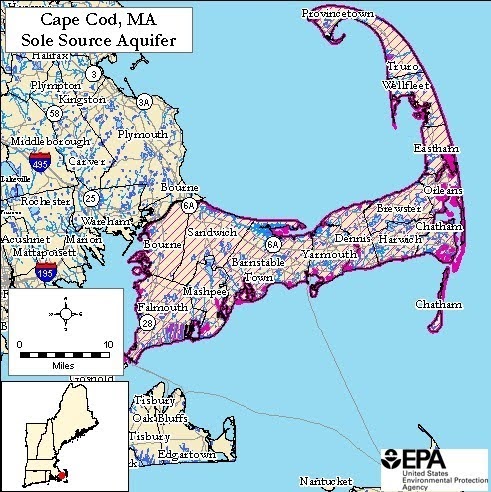 These recommendations will help ensure small arms range training at Camp Edwards poses no significant risk to groundwater.
Camp Edwards sits atop the Cape Cod Aquifer, the sole souce drinking water source of the Upper Cape. Construction of a multipurpose machine gun range stalled in 2023 after an EPA review identified potential risks to the aquifer. This study will review the current state of soil and groundwater contamination, assess monitoring plans and mitigation strategies for gun range contaminants, evaluate hydrologic and water quality models for contaminant fate and transport, and recommend updates to research, monitoring, and modeling activities to ensure small arms range training poses no significant risk to the underlying aquifer.
The National Academies of Sciences, Engineering, and Medicine are a non-governmental, non-profit organization chartered by the U.S. Congress in 1863 at the request of President Lincoln. The Academies have two missions: to honor the nation’s top scientists, engineers, and health professionals with membership, and to serve the nation with independent, expert advice.
A member of the UMD faculty since 1995, Professor Baecher received his B.S. in civil engineering from the University of California, Berkeley and his Ph.D. from the Massachusetts Institute of Technology. He served as chair of the CEE department from 1995 to 2003 and is now G.L. Martin Institute Professor of Engineering.
Published October 12, 2026
Recent Stories
Stories / Oct 19, 2026
Faeze Momeni Rad: Harnessing Advanced Tech for Safer Streets

Stories / Oct 14, 2026
Suyue Cao: “Forever Chemicals” Need Not Be Forever

Stories / Oct 12, 2026
Yang Takes the Helm at Maryland Transportation Institute

Stories / Oct 12, 2026
NASEM Announces Baecher’s Appointments to Two Committees

Stories / Oct 12, 2026
Concrete Day @ UMD Explores Future of Industry

Stories / Oct 5, 2026
Celebrating LGBTQ+ History Month 2026

Stories / Sep 22, 2026
Two Years Running, Maryland #12 Among Publics for Undergrad...

Stories / Sep 15, 2026
Chicago’s Perennial Potholes: UMD Professor Weighs In

Stories / Sep 10, 2026
Early Engagement

Stories / Aug 5, 2026
White Earth Tribal and Community College Hosts UMD Engineers
