News Story
CEE Department Welcomes Xudong Fan

The newest member of the University of Maryland’s (UMD) Department of Civil and Environmental Engineering faculty, Xudong (Andrew) Fan, joined the department in August 2026 as an assistant professor. His research explores the use of artificial intelligence (AI), advanced computing, and systems modeling to advance resilient and sustainable water systems across natural and built environments.
Together with his team at the Smart Urban Networks and Water Systems (SUNWater) research group, Fan leverages these tools to help deliver clean water to households by tracking its journey from the treatment plant through complex networks of pipelines. In another project, he is devising effective methods for managing extreme water events, such as flash floods, that pose an ongoing risk to the urban environment.
Efforts to ensure a clean drinking water supply, he points out, have long been hampered by the physical inaccessibility of the pipe system—teams can’t easily take samples from pipes that are buried deep underground.
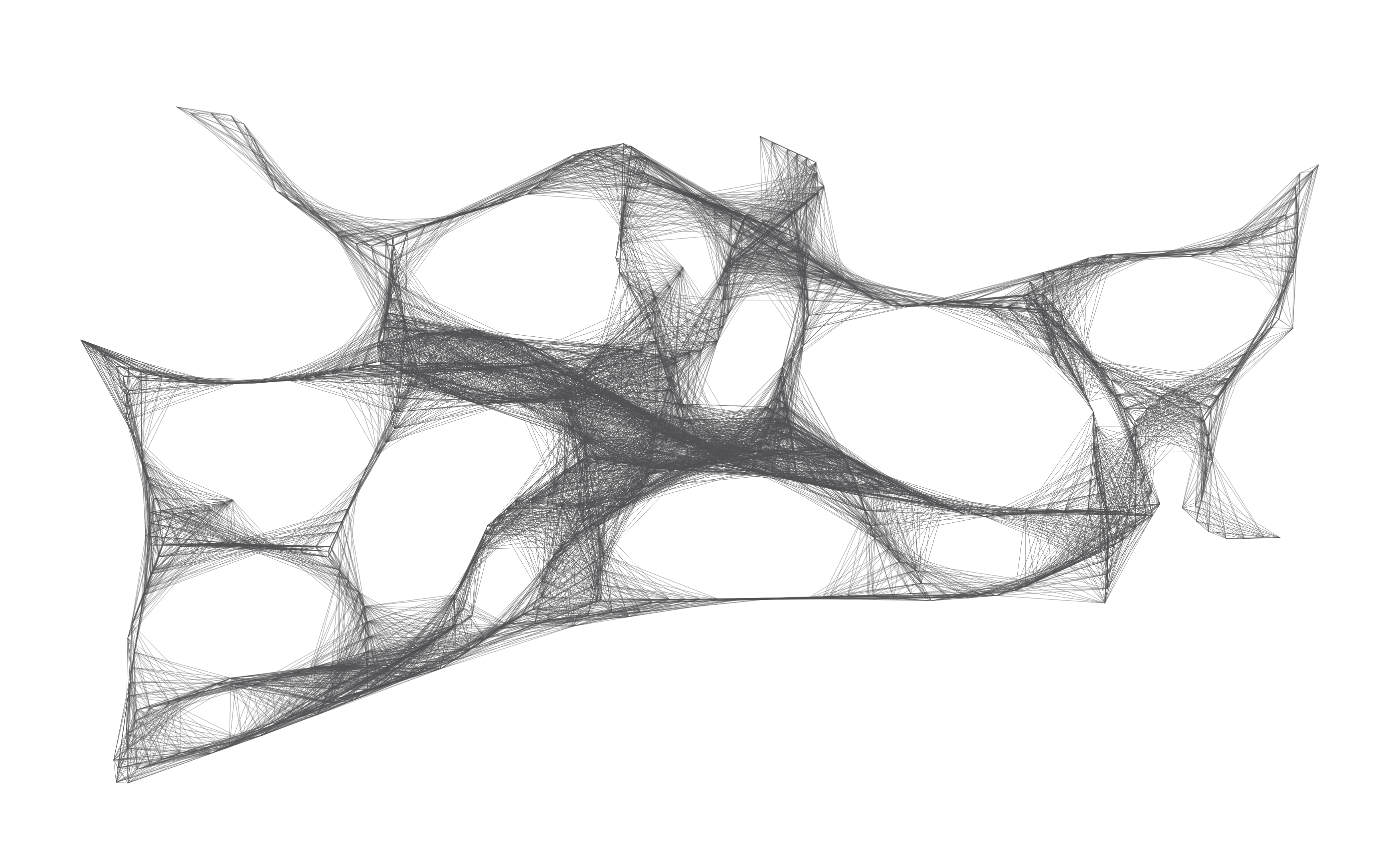
An illustration depicting graph representation learning, an approach used by Assistant Professor Xudong (Andrew) Fan and his team at SUNWater. In interconnected systems, such as water or power networks, each component is influenced not only by its immediate neighbors but also by more distant components. Fan’s research uses AI to learn these complex relationships, which can help predict how water, electricity, or other resources flow through a network.
“The journey from the plant to the customer can entail thousands or even hundreds of miles of pipes,” he said. “There are a lot of things that can happen along the way, from the water leakage to water quality concerns, and the aging water infrastructure makes the water management even challenging due to the pipe degradation and lack of detailed system information.”
Byproducts from water treatment, for example, can interact with the pipe materials, with the resulting mix ending up in our faucets. Aging pipes pose reliability issues that make public access to clean water. And the problem also flows in the other direction, as PFAs and other substances wash off household items into the water system.
To assess these risks without digging up pipes, Fan and his team use computational methods to develop physical simulations, factoring in equations that govern hydraulics and contaminant transport. AI, machine learning, and quantum engineering help drive these computationally intense methods, and solve the challenges that conventional simulation tools cannot achieve. Through such an approach, reliable inferences can be made about the state of a system and possible points of infrastructure degradation and water quality concerns, even when direct access is not possible.
“Until now, we could only examine these phenomena at the end points—that is, plant or household—and were limited in our ability to understand how the contaminants or hydraulic states are distributed spatially or temporarily during this process. We address the problem by developing a water hydraulic and contaminant profile to understand when and how contaminants have the largest impact,” said Fan, who has been collaborating with utilities in the area to pinpoint specific problems that his approach can help solve.
The other thrust of SUNWater research, examining urban flooding risks and other extreme water events, also involves the use of AI and advanced computing, in this case to forecast hazards and determine effective strategies for mitigating them, such as increasing the size of drainage pipes or utilizing valves to control water flow.
Both of his current research focus areas share a more fundamental concern with flow inside complex systems—a concern that links his work to that of researchers studying other kinds of networks, such as traffic, power system, material science, or even electronics transport at microscale. He is currently involved in interdisciplinary collaborations with researchers specializing in several of these areas.
A master’s degree graduate of Tianjin University, Fan received his Ph.D. from Case Western University in 2022, and then worked as a postdoctoral research associate at Princeton University. Before joining UMD, he was an assistant professor at the University at Buffalo.
Published October 22, 2026
Recent Stories
Stories / Oct 22, 2026
CEE Department Welcomes Xudong Fan

Stories / Oct 19, 2026
Faeze Momeni Rad: Harnessing Advanced Tech for Safer Streets

Stories / Oct 14, 2026
Suyue Cao: “Forever Chemicals” Need Not Be Forever

Stories / Oct 12, 2026
Yang Takes the Helm at Maryland Transportation Institute

Stories / Oct 12, 2026
NASEM Announces Baecher’s Appointments to Two Committees

Stories / Oct 12, 2026
Concrete Day @ UMD Explores Future of Industry

Stories / Oct 5, 2026
Celebrating LGBTQ+ History Month 2026

Stories / Sep 22, 2026
Two Years Running, Maryland #12 Among Publics for Undergrad...

Stories / Sep 15, 2026
Chicago’s Perennial Potholes: UMD Professor Weighs In

Stories / Sep 10, 2026
Early Engagement
